Choosing payroll software is relatively straightforward when all your employees work in one country. It becomes much more complicated when your company has employees, contractors, or remote workers spread across different countries.
That’s where global workforce platforms such as Deel and Rippling come into the picture.
Both platforms combine payroll and HR functionality, but they approach the market from somewhat different directions. Deel is particularly known for international hiring, Employer of Record (EOR) services, contractor management, and global workforce operations. Rippling is widely positioned as a broader workforce management platform combining HR, payroll, IT, benefits, and employee systems.
So, which one is better?
In this Deel Payroll vs Rippling comparison, we’ll examine global payroll, international hiring, EOR, contractor management, HR features, benefits, integrations, compliance, ease of use, pricing considerations, and which platform is better for different types of businesses.
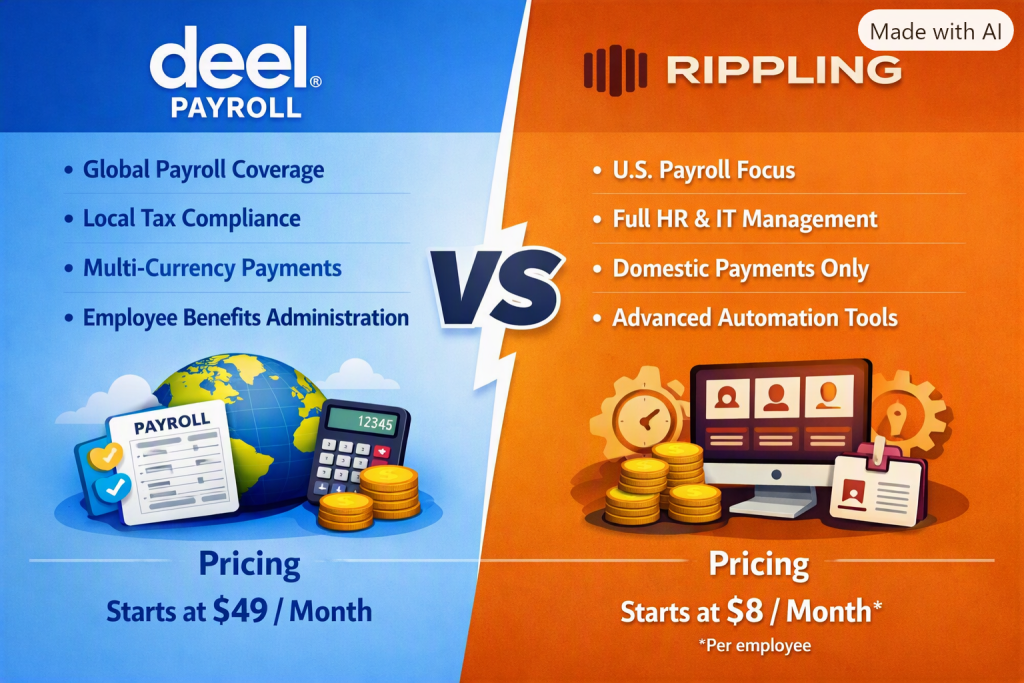
Deel vs Rippling: Quick Comparison
| Feature | Deel | Rippling |
|---|---|---|
| Global payroll | ⭐⭐⭐⭐⭐ | ⭐⭐⭐⭐ |
| U.S. payroll | ⭐⭐⭐⭐½ | ⭐⭐⭐⭐⭐ |
| International hiring | ⭐⭐⭐⭐⭐ | ⭐⭐⭐⭐ |
| EOR | ⭐⭐⭐⭐⭐ | ⭐⭐⭐⭐ |
| Contractor management | ⭐⭐⭐⭐⭐ | ⭐⭐⭐⭐ |
| Global compliance | ⭐⭐⭐⭐⭐ | ⭐⭐⭐⭐ |
| HR management | ⭐⭐⭐⭐⭐ | ⭐⭐⭐⭐⭐ |
| Benefits administration | ⭐⭐⭐⭐⭐ | ⭐⭐⭐⭐⭐ |
| IT/workforce management | ⭐⭐⭐⭐ | ⭐⭐⭐⭐⭐ |
| Integrations | ⭐⭐⭐⭐⭐ | ⭐⭐⭐⭐⭐ |
| Distributed teams | ⭐⭐⭐⭐⭐ | ⭐⭐⭐⭐⭐ |
| Best for | Global-first companies | Integrated HR + IT teams |
| Overall | 4.8/5 | 4.7/5 |
Quick Verdict
Choose Deel if international employment and global payroll are your priorities.
Choose Rippling if you want an integrated HR, payroll, benefits, and IT management platform, particularly for a U.S.-centric workforce.
What Is Deel Payroll?
Deel is a global workforce platform built around international hiring, payroll, HR administration, contractor management, and employee services.
Businesses can use Deel to manage different types of workers, including:
- Full-time employees
- International employees
- Contractors
- EOR employees
- Remote workers
- Distributed teams
Depending on the service selected, Deel can help companies manage payroll, employment contracts, onboarding, benefits, compliance workflows, international payments, and other workforce operations.
One of Deel’s biggest strengths is its focus on companies that hire internationally.
For example, a technology company headquartered in the United States could use Deel to manage employees in the UK, India, Germany, Canada, and other countries without building separate employment workflows for each location.
What Is Rippling?
Rippling is a workforce management platform that combines several business functions into a centralized system.
Its ecosystem can cover areas such as:
- Payroll
- HR
- Benefits
- Time and attendance
- Recruiting
- IT management
- Employee apps
- Workforce administration
- Automation
Rippling’s major differentiator is its ability to connect employee information with other workplace systems.
For example, when an employee joins a company, HR and IT processes can be connected so that onboarding doesn’t have to be handled manually across multiple systems.
This makes Rippling particularly attractive to businesses that want payroll and HR connected to employee technology management.
Deel Payroll vs Rippling: Global Payroll
Payroll is the most important comparison for companies with employees in multiple countries.
Deel Payroll
Deel is designed with global employment in mind.
Businesses can use its platform to manage international payroll-related processes while coordinating employee and contractor information from a centralized environment.
This can be especially useful when the workforce spans multiple countries and currencies.
Deel payroll advantages
- International payroll capabilities
- Global workforce support
- Contractor payments
- EOR payroll
- International employee administration
- Centralized workforce data
- Compliance-oriented workflows
Rippling Payroll
Rippling has strong payroll functionality, particularly for businesses managing U.S. employees.
Its payroll system is closely connected with HR and other workforce functions.
This integration can be valuable for businesses that want payroll to automatically interact with employee records, benefits, time tracking, and other HR processes.
Winner: Deel for global payroll
If the primary requirement is international payroll across multiple countries, Deel has the advantage.
If you’re primarily managing a U.S.-based workforce and want payroll tightly connected to HR and IT, Rippling can be an excellent choice.
Deel vs Rippling for International Hiring
International hiring is one of the biggest differences between the two platforms.
Deel
Deel is built around global hiring.
Businesses can use its EOR and international employment capabilities to hire workers in countries where they may not have their own legal entity.
This can reduce the operational complexity involved in expanding into new markets.
Rippling
Rippling also supports international workforce management, but its overall positioning is broader than international employment alone.
For businesses that already have an established HR infrastructure and need a comprehensive workforce platform, Rippling may be attractive.
Winner: Deel
Deel is the stronger choice for businesses where international hiring is central to their growth strategy.
Deel vs Rippling for Employer of Record
Employer of Record services are important for businesses that want to hire employees internationally without establishing a local legal entity.
The EOR becomes the legal employer while the client company manages the employee’s daily responsibilities.
Deel EOR
Deel’s EOR offering is one of its core strengths.
Businesses can use it to support international employment processes including:
- Contracts
- Onboarding
- Payroll
- Benefits
- Tax-related administration
- Local employment requirements
- Employee management
Rippling EOR
Rippling also supports international workforce requirements, but companies should evaluate the specific countries and employment structures they need.
For a company whose primary objective is international EOR hiring, Deel’s global-first approach may be more compelling.
Winner: Deel
Deel wins for companies specifically looking for a global EOR platform.
Deel vs Rippling for Contractor Management
Contractors are increasingly important for startups, agencies, technology companies, and remote-first businesses.
Managing international contractors can involve:
- Contracts
- Invoices
- Payments
- Tax documentation
- Compliance
- Worker classification
- Onboarding
- Record keeping
Deel
Contractor management is a major part of Deel’s platform.
Businesses can onboard and pay contractors internationally while maintaining centralized records.
This makes Deel particularly useful for organizations that use a mix of employees and independent contractors.
Rippling
Rippling can also support contractor and workforce management, particularly when contractors form part of a larger HR ecosystem.
Winner: Deel
Deel has the edge for businesses with a large or geographically distributed contractor workforce.
Global Compliance: Deel vs Rippling
Global employment introduces additional compliance responsibilities.
Different countries can have different rules covering:
- Payroll taxes
- Social contributions
- Employment contracts
- Paid leave
- Benefits
- Working hours
- Termination
- Worker classification
- Reporting
Deel
Global compliance is central to Deel’s international employment model.
The platform is designed to help businesses manage country-specific employment workflows while reducing the administrative burden of international expansion.
Rippling
Rippling also provides compliance-related workforce functionality, especially within its HR and payroll ecosystem.
However, companies with extensive international hiring requirements should evaluate country availability and the exact employment services offered.
Winner: Deel for international compliance
Deel is generally the better fit for companies dealing with complex international employment requirements.
Deel vs Rippling: HR Management
This is where Rippling becomes particularly competitive.
Deel HR
Deel has expanded beyond payroll and EOR into broader workforce management.
Businesses can manage areas such as:
- Employee information
- Onboarding
- Time off
- Benefits
- Workforce administration
- Payroll
- Contractor management
Rippling HR
Rippling has a strong HR foundation.
Its platform can connect:
HR + Payroll + Benefits + IT + Apps + Automation
This integrated architecture is one of Rippling’s major selling points.
Winner: Rippling
For businesses looking for a comprehensive HR management and workforce operations platform, Rippling has an advantage.
Deel vs Rippling: Benefits Administration
Benefits are another area where both platforms can be useful.
Businesses may need to manage:
- Health benefits
- Retirement plans
- Insurance
- Employee perks
- Country-specific benefits
- Enrollment
- Benefits administration
Deel
Deel provides benefits capabilities as part of its broader global workforce platform.
This can be useful for companies managing employees across different countries.
Rippling
Rippling integrates benefits with employee and payroll information.
This can simplify administration for companies that want benefits connected directly to their HR system.
Winner: Tie
For global benefits, Deel is particularly attractive.
For integrated HR and benefits administration, Rippling has a strong advantage.
Deel vs Rippling: IT Management
This is one category where Rippling clearly stands out.
Rippling can connect employee information with IT and workplace technology.
Depending on the services used, organizations can manage areas such as:
- Employee devices
- Applications
- User accounts
- Access
- Software provisioning
- Employee onboarding
- Offboarding
Deel is primarily focused on workforce and employment management rather than being an all-in-one IT administration platform.
Winner: Rippling
If your goal is to combine HR, payroll, and IT management, Rippling is the stronger choice.
Deel vs Rippling: Automation
Automation can dramatically reduce repetitive HR and payroll tasks.
Deel
Deel can automate many international workforce workflows, including onboarding, payments, employee administration, and other processes.
Rippling
Automation is one of Rippling’s strongest selling points because employee data can trigger actions across multiple business systems.
For example:
New employee → HR record → payroll → benefits → applications → IT access
This type of connected workflow can eliminate significant manual administration.
Winner: Rippling
For broader cross-system automation, Rippling gets the edge.
Deel vs Rippling: Integrations
Modern HR departments rarely use a single application.
They may need connections with:
- Accounting systems
- Applicant tracking systems
- Time tracking
- Expense management
- Identity providers
- Communication tools
- Productivity applications
- Finance systems
Both Deel and Rippling support integrations.
Rippling’s advantage comes from connecting HR data with IT and workplace applications.
Deel’s advantage is its focus on connecting global workforce operations.
Winner: Tie
The better option depends on the software already used by your company.
Deel vs Rippling: Ease of Use
Both platforms aim to centralize complex workforce processes.
Deel
Deel can be relatively straightforward for companies primarily looking to:
- Hire internationally
- Onboard workers
- Manage payroll
- Pay contractors
- Manage EOR employees
Its global focus gives the platform a clear use case.
Rippling
Rippling provides a wider range of functionality.
That can be powerful, but businesses may need more configuration because HR, payroll, benefits, IT, and other services can all interact.
Winner: Depends
Deel is often easier for international employment workflows.
Rippling can be more powerful for companies seeking a connected HR and IT ecosystem.
Deel vs Rippling Pricing
Pricing should be evaluated carefully because neither platform’s headline price tells the complete story for every business.
Your total cost can depend on:
- Number of employees
- Countries
- Payroll requirements
- EOR usage
- Contractors
- Benefits
- HR modules
- IT services
- Integrations
- Additional features
For this reason, companies should compare quotes based on their actual workforce rather than assuming one platform will always be cheaper.
Which Is Cheaper?
There is no universal answer.
A small U.S. company may find Rippling’s structure attractive if it needs payroll, HR, benefits, and IT.
A global startup may find Deel more appropriate if it needs EOR and international contractor management.
Compare total cost of ownership, not just the starting subscription price.
Deel vs Rippling for Startups
Startups often need to move quickly.
They may begin with a small team and then hire internationally within months.
Deel for startups
Deel is particularly useful for startups that:
- Hire internationally
- Use contractors
- Operate remotely
- Need EOR services
- Expect rapid global expansion
- Want international payments
Rippling for startups
Rippling can be a strong option for startups that want to build a connected HR and IT infrastructure early.
It can be especially useful when the workforce is primarily based in the U.S.
Winner: Deel for global startups
Choose Deel if international hiring is a major part of your startup strategy.
Choose Rippling if your startup is primarily U.S.-based and wants HR + payroll + IT integration.
Deel vs Rippling for Small Businesses
Small businesses often don’t have large HR departments.
They need software that can reduce administrative work.
Deel
Deel is well suited to small businesses hiring internationally without creating separate systems for every country.
Rippling
Rippling is attractive to small businesses that want to centralize payroll, HR, benefits, and employee technology.
Winner: Depends on workforce structure
Global small business → Deel
U.S.-focused small business with integrated HR/IT needs → Rippling
Deel vs Rippling for Large Companies
Large businesses often need scalability and integrations.
They may have:
- Multiple countries
- Multiple payroll systems
- Hundreds or thousands of employees
- Complex HR workflows
- IT requirements
- Benefits programs
- Contractor populations
- Compliance requirements
Both platforms can potentially fit larger organizations, but their strengths are different.
Deel
Best suited to organizations with substantial international employment and contractor requirements.
Rippling
Best suited to organizations that want HR, payroll, benefits, and IT managed through a connected workforce platform.
Winner: Depends
For a global-first organization, Deel gets the advantage.
For a company seeking HR + IT + payroll integration, Rippling can be the better fit.
Deel vs Rippling: Pros and Cons
Deel Pros
- Strong global payroll capabilities
- Excellent international hiring infrastructure
- EOR services
- Contractor management
- International payments
- Global workforce management
- Benefits support
- Strong option for distributed teams
- Designed for international expansion
Deel Cons
- May offer more functionality than a company with simple payroll needs requires
- Pricing varies according to services and workforce structure
- Companies should verify specific country requirements before choosing an international employment model
Rippling Pros
- Strong payroll platform
- Comprehensive HR functionality
- Benefits administration
- IT management
- Application management
- Workforce automation
- Strong integrations
- Excellent employee lifecycle workflows
- Particularly attractive for U.S.-centric organizations
Rippling Cons
- Broader platform can require more configuration
- International requirements should be evaluated country by country
- Companies primarily seeking EOR services may prefer a global-first provider
Deel vs Rippling: Which Is Better for Remote Teams?
Both platforms can work well for remote teams, but their strengths differ.
Choose Deel when:
- Employees live in multiple countries
- You hire international contractors
- You need EOR services
- Global payroll is important
- You are expanding internationally
Choose Rippling when:
- Most employees are in the U.S.
- You want HR and payroll together
- IT management is important
- You need automated employee provisioning
- You want applications and employee data connected
Deel vs Rippling: Which Is Better for Global Payroll?
If the primary question is “Which platform should I choose for global payroll?”, Deel gets the advantage.
Deel’s platform is heavily focused on international employment, global workforce management, EOR, and contractor payments.
Rippling’s strength is different.
It offers a broader connected workforce ecosystem that can bring together payroll, HR, benefits, IT, and employee applications.
Therefore:
Global payroll + international hiring → Deel
Payroll + HR + IT ecosystem → Rippling
Deel vs Rippling: Feature-by-Feature Winner
| Category | Winner |
|---|---|
| Global payroll | Deel |
| U.S. payroll | Rippling |
| International hiring | Deel |
| EOR | Deel |
| Contractor management | Deel |
| Global compliance | Deel |
| HR management | Rippling |
| Benefits | Tie |
| IT management | Rippling |
| Automation | Rippling |
| Global workforce management | Deel |
| Integrations | Tie |
| Distributed teams | Deel |
| U.S.-focused businesses | Rippling |
| International startups | Deel |
| Overall global workforce platform | Deel |
Who Should Choose Deel?
Deel is the better choice if your company:
- Hires employees internationally
- Uses international contractors
- Needs EOR services
- Operates across multiple countries
- Needs global payroll
- Has a distributed workforce
- Wants international payment infrastructure
- Plans to expand into new countries
For these businesses, Deel’s global-first approach can be a major advantage.
Who Should Choose Rippling?
Rippling is likely the better choice if your company:
- Is primarily U.S.-based
- Wants payroll and HR in one platform
- Needs benefits administration
- Wants integrated IT management
- Requires application provisioning
- Wants employee lifecycle automation
- Values deep workforce integrations
Its ability to connect HR and IT is one of its biggest differentiators.
Final Verdict: Deel Payroll vs Rippling
So, Deel Payroll vs Rippling—which one should you choose?
The answer depends heavily on what “global” means for your company.
If global means employees and contractors working across many countries, Deel is the stronger choice.
If global means a growing company that needs a connected HR, payroll, benefits, and IT platform, Rippling deserves serious consideration.
Our Overall Ratings
Deel: ⭐⭐⭐⭐⭐ 4.8/5
Rippling: ⭐⭐⭐⭐⭐ 4.7/5
Overall Winner: Deel
Deel wins this comparison because of its stronger focus on international hiring, global payroll, EOR services, contractor management, and distributed workforce operations.
However, Rippling can be the better platform for U.S.-centric businesses that want HR, payroll, benefits, IT, and employee applications connected in one ecosystem.
The smartest decision is to map your actual workforce before choosing:
Countries → Employees → Contractors → Payroll → Benefits → HR → IT → Integrations
Then compare the total cost and functionality of both platforms against those requirements.
Frequently Asked Questions
Is Deel better than Rippling?
For international payroll, EOR, global hiring, and contractor management, Deel is generally the stronger option. Rippling can be better for companies seeking an integrated HR, payroll, benefits, and IT platform.
Is Rippling better than Deel for U.S. payroll?
Rippling can be an excellent choice for U.S.-based companies that want payroll integrated with HR, benefits, IT, and employee management.
Does Deel offer global payroll?
Yes. Deel is designed to support international workforce and payroll operations across multiple countries, subject to the specific services and locations supported.
Does Rippling support international employees?
Rippling supports international workforce management, but businesses should evaluate the exact countries, payroll services, EOR options, and employment structures required for their workforce.
Which is better for contractors, Deel or Rippling?
Deel generally has the advantage for businesses managing international contractors because contractor management and international payments are core parts of its platform.
Which is better for EOR services?
Deel is generally the stronger choice for businesses whose primary requirement is international Employer of Record services.
Is Deel good for startups?
Yes. Deel can be particularly useful for startups that expect to hire internationally, use contractors, or expand into multiple countries.
Is Rippling good for small businesses?
Yes. Rippling can be particularly valuable for small and growing businesses that want payroll, HR, benefits, IT, and employee management connected in one system.
Can Deel replace HR software?
For some companies, Deel can cover a substantial portion of HR and workforce administration. However, businesses with specialized HR, IT, recruiting, or enterprise requirements may still need additional systems.
Which should I choose: Deel or Rippling?
Choose Deel if international employment and global payroll are your primary priorities. Choose Rippling if you want a broader HR + payroll + benefits + IT ecosystem, particularly for a U.S.-focused workforce.


