Hiring employees across multiple countries sounds exciting—until payroll, tax compliance, local employment laws, contracts, benefits, and payments enter the picture.
Two platforms that frequently come up when businesses compare global employment and payroll solutions are Deel and Remote. Both are designed to help companies hire and manage international workers while reducing the administrative burden associated with operating across borders.
But which platform is better for your business?
In this Deel Payroll vs Remote comparison, we’ll look at their global payroll capabilities, employer of record (EOR) services, contractor management, compliance, onboarding, benefits, integrations, pricing considerations, and overall usability.
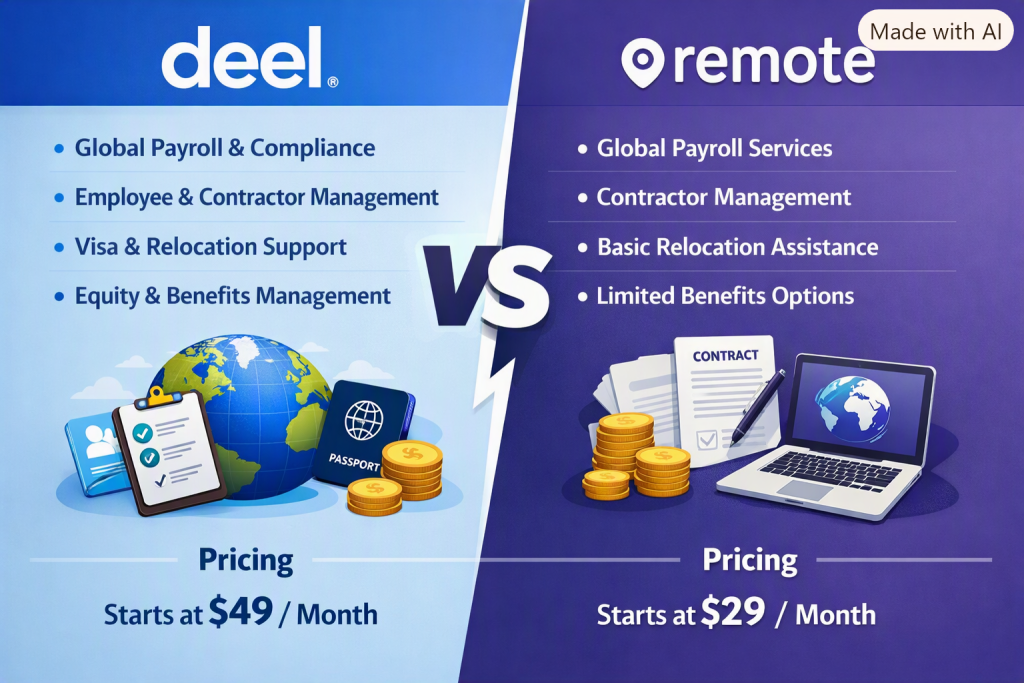
Deel vs Remote: Quick Comparison
| Feature | Deel | Remote |
|---|---|---|
| Global payroll | Yes | Yes |
| Employer of Record (EOR) | Yes | Yes |
| Contractor management | Yes | Yes |
| International hiring | Excellent | Excellent |
| Payroll automation | Excellent | Excellent |
| Global compliance | Strong | Strong |
| Employee benefits | Yes | Yes |
| Contractor payments | Yes | Yes |
| HR management | Yes | Yes |
| Global workforce support | Excellent | Excellent |
| Best suited for | Growing global teams | Companies prioritizing international employment |
| Overall | ⭐⭐⭐⭐⭐ | ⭐⭐⭐⭐½ |
Winner for overall global workforce management: Deel
Best alternative: Remote
The right choice ultimately depends on your hiring countries, workforce structure, payroll requirements, and the level of HR automation you need.
What Is Deel Payroll?
Deel is a global workforce platform designed to help businesses hire, pay, and manage employees and contractors internationally.
Rather than building separate payroll processes for every country, companies can use Deel to centralize many workforce operations in one platform.
Depending on the service selected, businesses can use Deel for:
- Global payroll
- Employer of Record services
- Contractor management
- International payments
- Employee onboarding
- Benefits administration
- Compliance support
- HR management
- Time off and workforce management
- Global workforce reporting
This makes Deel particularly attractive to startups, technology companies, remote-first businesses, agencies, and organizations building distributed teams.
Why Businesses Choose Deel
One of Deel’s biggest advantages is its broad international workforce infrastructure.
A company may have employees in the United States, contractors in India, developers in Eastern Europe, and sales employees in the UK. Instead of maintaining completely separate systems, the business can use a centralized platform for many workforce processes.
What Is Remote?
Remote is a global HR and employment platform focused on helping companies employ and manage international workers.
Its services include:
- Employer of Record
- Global payroll
- Contractor management
- International hiring
- Employee benefits
- Compliance support
- HR administration
- Global workforce management
Remote is particularly focused on simplifying international employment for companies that want to hire employees in countries where they don’t have their own legal entities.
For example, a U.S.-based company could use an EOR service to hire an employee in another country without immediately establishing a local subsidiary.
Deel Payroll vs Remote: Global Payroll
Payroll is one of the most important areas to compare when choosing an international workforce platform.
Deel
Deel provides global payroll capabilities designed to help businesses manage payroll across multiple countries from a centralized environment.
Depending on the plan and country, businesses can manage areas such as:
- Employee payroll
- Contractor payments
- Tax-related payroll administration
- Currency conversion and international payments
- Payroll reporting
- Compliance workflows
- Employee information
For companies managing employees across several countries, having centralized payroll administration can significantly reduce manual work.
Remote
Remote also provides global payroll capabilities and supports businesses managing international employees.
The platform aims to simplify payroll administration while handling country-specific requirements through its global infrastructure.
Winner: Deel
Deel gets the edge for businesses that want a broad global workforce platform alongside payroll.
Remote remains a strong option, especially for companies primarily focused on international employment and EOR services.
Deel vs Remote for Employer of Record
An Employer of Record allows a company to hire workers internationally without establishing its own legal entity in every country.
The EOR generally becomes the legal employer while the client company manages the employee’s day-to-day work.
Deel EOR
Deel’s EOR offering is designed for companies that want to hire international employees quickly while reducing the need to establish local entities.
Businesses can typically manage:
- Employment contracts
- Employee onboarding
- Payroll
- Taxes
- Benefits
- Time off
- Compliance-related administration
Remote EOR
Remote is also well known for its EOR model.
Its platform focuses heavily on helping businesses employ international workers while managing local employment requirements.
Remote can be particularly appealing to companies that want a straightforward international hiring experience.
Winner: Tie
Both platforms are strong EOR choices.
Your decision should depend more on:
- Countries you are hiring in
- Pricing
- Benefits requirements
- Employee experience
- Contract requirements
- Payroll needs
- Desired HR integrations
Deel vs Remote for Contractors
International contractors can introduce different compliance and payment challenges.
Businesses need to create appropriate agreements, collect contractor information, process payments, maintain records, and reduce the risk of worker misclassification.
Deel Contractor Management
Deel provides tools for onboarding and paying contractors internationally.
Businesses can use the platform to manage:
- Contractor agreements
- Onboarding
- Payments
- Invoices
- Compliance workflows
- Contractor information
- Payment history
This makes Deel particularly useful for companies that have a mixed workforce.
Remote Contractor Management
Remote also supports contractor management and international contractor payments.
Companies can use Remote to bring contractors into a centralized workforce management process.
Winner: Deel
Deel has a slight advantage for companies managing a combination of contractors and employees across multiple countries.
Global Compliance: Deel vs Remote
International employment compliance is one of the biggest reasons companies use global payroll platforms.
Every country can have different requirements for:
- Employment contracts
- Minimum wages
- Payroll taxes
- Social contributions
- Employee benefits
- Paid leave
- Termination procedures
- Working hours
- Reporting
Trying to manage these requirements manually can become difficult as the workforce expands.
Deel Compliance
Deel provides country-specific employment and payroll infrastructure designed to help businesses manage international workforce requirements.
Its centralized approach can be useful when a company is hiring across multiple jurisdictions.
Remote Compliance
Remote also emphasizes localized employment compliance and international HR administration.
The platform helps businesses navigate country-specific employment requirements when using its global employment services.
Winner: Tie
Both platforms are designed to reduce the administrative burden of international compliance.
However, businesses should still verify specific country requirements with qualified legal or tax professionals when making important employment decisions.
Deel vs Remote: Employee Benefits
Benefits can be an important factor when recruiting international employees.
Depending on the country, employees may expect access to benefits such as:
- Health insurance
- Retirement plans
- Paid leave
- Local statutory benefits
- Additional employee perks
Deel
Deel provides global benefits capabilities as part of its broader workforce platform.
This can make it easier to manage benefits alongside payroll and employee administration.
Remote
Remote also offers benefits for international employees, with availability depending on the country and service.
Winner: Deel
Deel has an advantage for businesses looking to manage benefits alongside a wider collection of workforce services.
Ease of Use
A global payroll platform should make complicated processes feel simple.
Deel User Experience
Deel is designed around a centralized dashboard where businesses can manage different parts of their international workforce.
Its broad feature set can be especially useful for companies managing multiple worker types.
The trade-off is that businesses may need some time to become familiar with all the available features.
Remote User Experience
Remote also focuses on simplifying international employment and HR administration.
Its platform can be appealing to companies that want a streamlined approach to managing international employees.
Winner: Depends
Choose Deel if you want broader workforce functionality.
Choose Remote if you prefer a focused international employment experience.
Deel vs Remote Pricing
Pricing is one of the most important considerations, but it is also one of the areas where businesses should avoid relying on a single headline number.
The actual cost can depend on:
- Number of employees
- Countries
- EOR vs direct payroll
- Contractor services
- Benefits
- Payroll requirements
- Currency
- Additional HR services
- Contract length
For that reason, businesses should request a current quote based on their actual workforce structure.
Which Is Cheaper?
There isn’t a universal winner.
A platform that appears cheaper at the base level may become more expensive once additional services, benefits, payroll requirements, or country-specific costs are included.
The better approach is to compare the total cost for your actual employee and contractor list.
Deel vs Remote: Integrations
Integrations become increasingly important as companies grow.
A global payroll platform may need to connect with:
- Accounting software
- HRIS platforms
- Expense management
- Time tracking
- Identity management
- Recruitment systems
- Finance tools
Deel’s broad ecosystem makes it attractive to companies building a larger HR and finance technology stack.
Remote also supports integrations and workflows designed to connect global employment operations with other business systems.
Winner: Deel
For organizations looking for a broader global workforce ecosystem, Deel has the advantage.
Deel vs Remote for Startups
Startups often need to hire internationally before they have the resources to create local entities or build dedicated HR operations.
Deel for Startups
Deel can be useful for startups that:
- Hire internationally
- Use contractors
- Have remote employees
- Need centralized payroll
- Expect rapid international expansion
- Want to manage employees and contractors in one platform
Remote for Startups
Remote can be a strong choice for startups primarily focused on hiring international employees through EOR services.
Winner: Deel
For startups with a mixed international workforce, Deel is generally the more versatile option.
Deel vs Remote for Small Businesses
Small businesses typically want to avoid complex HR administration.
The ideal platform should make it easy to:
- Add workers
- Complete onboarding
- Create appropriate contracts
- Run payroll
- Process payments
- Manage benefits
- Maintain workforce records
Deel’s broader functionality can be valuable for small businesses expecting international growth.
Remote can be attractive for smaller companies with a more focused EOR requirement.
Winner: Deel
Deel gets the edge for small businesses with diverse workforce requirements.
Deel vs Remote for Large Companies
Larger companies often have more complicated requirements.
They may need:
- Multi-country payroll
- Multiple worker types
- Reporting
- HR integrations
- Benefits administration
- Compliance workflows
- Centralized workforce data
- Scalable onboarding
Both platforms can support international expansion, but the best option depends heavily on the company’s existing HR infrastructure.
Winner: Deel
For companies seeking a broad international workforce management platform, Deel is often the stronger all-in-one choice.
Deel vs Remote: Pros and Cons
Deel Pros
- Broad global workforce platform
- Strong international hiring capabilities
- Contractor and employee management
- Global payroll support
- EOR services
- International payments
- Benefits management
- Centralized workforce administration
- Useful for distributed teams
Deel Cons
- Broad feature set can feel complex for smaller requirements
- Pricing depends on services and countries
- Businesses should compare quotes for their specific workforce
Remote Pros
- Strong international employment platform
- EOR capabilities
- Global payroll support
- Contractor management
- International benefits
- Focus on remote and distributed employment
- Useful for companies hiring internationally
Remote Cons
- Some businesses may need additional tools for broader HR workflows
- Pricing varies depending on country and services
- Feature requirements should be evaluated against existing HR systems
Deel vs Remote: Which Is Better for Global Payroll?
If your main goal is to find a platform for managing an increasingly distributed international workforce, Deel is the stronger overall choice.
Its biggest advantage is the combination of:
Payroll + EOR + Contractors + Payments + Benefits + HR workflows
That broader ecosystem can reduce the number of separate systems a growing international business needs.
Remote is still an excellent alternative, particularly for organizations that prioritize international employment and EOR capabilities.
Deel vs Remote: Feature-by-Feature Winner
| Category | Winner |
|---|---|
| Global payroll | Deel |
| EOR | Tie |
| Contractor management | Deel |
| International hiring | Tie |
| Compliance | Tie |
| Benefits | Deel |
| Workforce flexibility | Deel |
| Ease of use | Tie |
| Global workforce management | Deel |
| Startups | Deel |
| Small businesses | Deel |
| Large distributed teams | Deel |
| Overall | Deel |
Who Should Choose Deel?
Deel is a particularly good fit if your business:
- Hires employees in multiple countries
- Works with international contractors
- Needs EOR services
- Wants centralized payroll
- Is building a distributed workforce
- Wants international payments
- Needs benefits administration
- Expects rapid global expansion
- Wants multiple workforce services under one platform
For these businesses, Deel’s breadth can be a major advantage.
Who Should Choose Remote?
Remote may be the better choice if your organization:
- Primarily needs international employment services
- Is heavily focused on EOR
- Wants to hire employees overseas
- Has a relatively straightforward international workforce
- Prefers a focused global employment platform
- Finds Remote’s pricing and country coverage more suitable
Remote shouldn’t be dismissed simply because Deel offers a broader feature set. In some organizations, a more focused platform may be exactly what the HR team needs.
Final Verdict: Deel Payroll vs Remote
So, Deel Payroll vs Remote—which global payroll platform is better?
For most companies building a distributed international workforce, Deel is the better overall platform.
Its combination of global payroll, EOR, contractor management, international payments, benefits, and workforce administration makes it particularly well suited to businesses that expect their international operations to grow.
Remote is the better alternative for companies that place greater emphasis on international employment and EOR services and find its country coverage, pricing, and workflows a better match.
Our Overall Rating
Deel: ⭐⭐⭐⭐⭐ 4.8/5
Remote: ⭐⭐⭐⭐½ 4.6/5
If your business manages employees + contractors across multiple countries, Deel is the platform I’d shortlist first.
If your requirements are primarily centered around international EOR hiring, compare Deel and Remote side-by-side using your actual countries, employee count, benefits requirements, and payroll needs before making the final decision.
Frequently Asked Questions
Is Deel better than Remote?
For many businesses, yes. Deel offers a broader combination of global payroll, EOR, contractor management, payments, benefits, and workforce management. Remote remains a strong alternative, especially for companies focused heavily on international employment.
Is Deel cheaper than Remote?
Not necessarily. Pricing depends on countries, worker types, services, benefits, and contract requirements. Businesses should request current quotes based on their actual workforce.
Does Remote offer global payroll?
Yes. Remote provides global payroll and international employment services, subject to the countries and services supported.
Can Deel manage contractors?
Yes. Deel supports international contractor onboarding, agreements, payments, and related workforce administration.
Can Deel and Remote replace traditional payroll software?
For some international workforce scenarios, they can replace or significantly reduce the need for separate payroll and employment administration systems. However, businesses with complex domestic payroll requirements should evaluate the specific countries, entities, integrations, and payroll workflows they need.
Which is better for a remote-first company?
Both can work well. Deel is generally the stronger choice for a remote-first company with a diverse mix of employees and contractors, while Remote can be an excellent option for companies primarily focused on international employment.
Which platform is better for startups?
Deel is usually the stronger choice for startups expecting rapid international expansion because it combines several workforce functions in one platform.
Should I choose Deel or Remote?
Start by listing your hiring countries, employee and contractor counts, payroll requirements, benefits, integrations, and expected expansion. Then compare the total cost and workflows for both platforms. For a broad global workforce platform, Deel is our overall pick.


