As businesses expand across borders and embrace remote work, payroll has become much more than simply paying employees on time. Employers must also comply with tax regulations, labor laws, social security contributions, reporting requirements, employee classifications, and country-specific payroll rules.
For companies hiring in multiple countries, payroll compliance can quickly become one of the most complex operational responsibilities. A single mistake—whether it’s an incorrect tax deduction, a missed reporting deadline, or a worker misclassification—can result in financial penalties, legal disputes, and damaged employee trust.
This is why many organizations use Deel Payroll to support their global payroll operations. By combining payroll processing, compliance tools, workforce management, and localized payroll workflows into one platform, Deel helps businesses reduce administrative burden while managing payroll across international teams.
In this post, we’ll explain how Deel Payroll helps businesses stay payroll compliant, the features that support compliance, and why automation has become essential for modern employers.
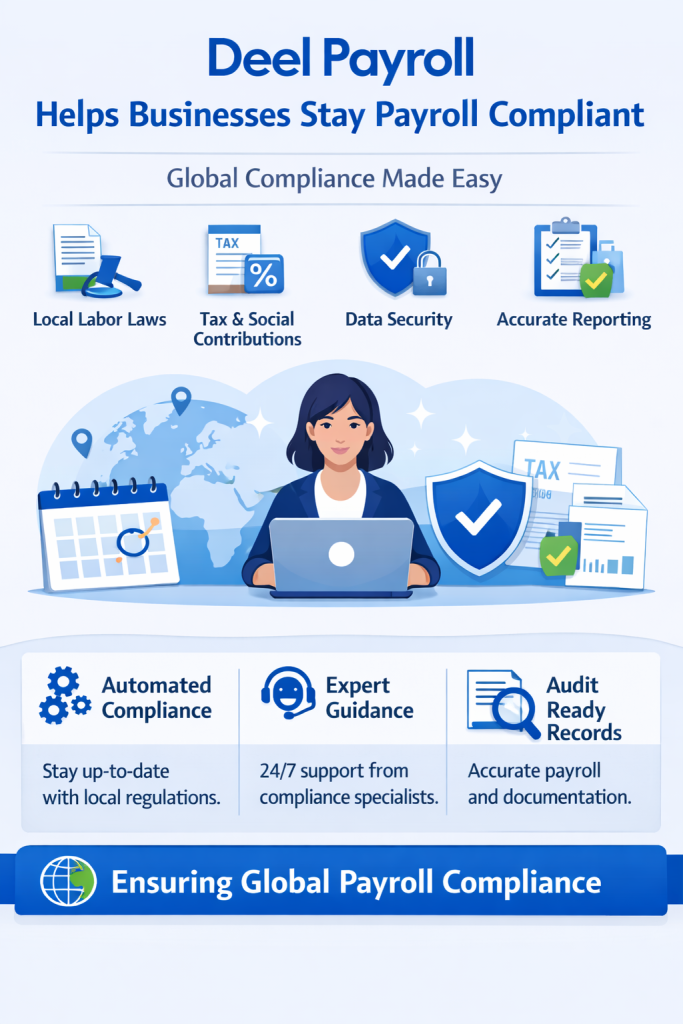
What Is Payroll Compliance?
Payroll compliance refers to following all applicable laws and regulations related to paying employees.
Depending on the country, payroll compliance may include:
- Paying employees accurately and on time
- Withholding payroll taxes correctly
- Making employer tax contributions
- Managing social security payments
- Following minimum wage laws
- Providing statutory employee benefits
- Maintaining payroll records
- Issuing compliant payslips where required
- Meeting payroll reporting deadlines
- Following employment regulations
Because these rules vary between countries—and often change over time—maintaining compliance can be challenging for businesses operating internationally.
Why Payroll Compliance Matters
Payroll compliance isn’t just about avoiding penalties. It also helps businesses:
- Build employee trust
- Protect their reputation
- Reduce legal risks
- Improve payroll accuracy
- Support international expansion
- Maintain organized financial records
- Strengthen HR operations
Companies with strong payroll processes are often better positioned for long-term growth.
How Deel Payroll Supports Payroll Compliance
1. Localized Payroll Workflows
Every country has unique payroll regulations.
For example, employers may need to calculate:
- Income tax withholdings
- Social security contributions
- Pension deductions
- Mandatory insurance payments
- Paid leave entitlements
- Employer payroll taxes
Deel supports localized payroll workflows that are designed to align with country-specific payroll requirements, reducing the need for manual configuration.
2. Payroll Automation
Manual payroll calculations are one of the most common sources of compliance errors.
Deel automates many repetitive payroll tasks, including:
- Salary calculations
- Payroll deductions
- Bonus processing
- Reimbursements
- Payroll scheduling
- Payslip generation where applicable
Automation helps improve consistency while reducing administrative workload.
3. Employer of Record (EOR) Services
Many businesses want to hire employees overseas without establishing local legal entities.
Through its Employer of Record (EOR) service in supported countries, Deel enables businesses to hire employees using a locally compliant employment structure.
This simplifies international hiring while reducing the operational complexity of managing employment relationships in unfamiliar jurisdictions.
4. Employee Classification Support
One of the most common compliance risks is incorrectly classifying workers.
Businesses often work with:
- Full-time employees
- Part-time employees
- Independent contractors
- Freelancers
- Temporary workers
Misclassification can result in legal and financial consequences.
Deel provides structured onboarding and workforce management tools that help businesses organize different worker types appropriately, though employers remain responsible for correct classification under applicable law.
5. Centralized Employee Documentation
Payroll compliance depends on maintaining accurate records.
Deel allows businesses to organize important documents, including:
- Employment contracts
- Payroll records
- Tax-related forms
- Identity documentation
- Compensation records
- Employee agreements
Centralized storage helps simplify recordkeeping and improves accessibility during audits or internal reviews.
6. Payroll Reporting
Accurate reporting is essential for payroll management.
Deel provides payroll reporting tools that help businesses review:
- Payroll expenses
- Employee compensation
- Department costs
- Country-specific payroll data
- Payroll history
These reports support financial planning while helping organizations maintain organized payroll records.
7. Multi-Country Payroll Management
Managing payroll across several countries often requires multiple payroll providers.
Deel centralizes payroll operations through a unified dashboard where businesses can oversee international payroll from one location.
This reduces complexity and improves operational visibility.
Compliance Challenges Deel Helps Simplify
Businesses hiring internationally often face challenges such as:
Different Tax Systems
Every country has unique payroll tax structures.
Multiple Payroll Calendars
Payroll frequencies vary between countries and employment agreements.
Currency Management
International employees may receive salaries in different currencies.
Employee Benefits
Mandatory benefits differ depending on local employment regulations.
Regulatory Changes
Employment laws evolve regularly, requiring payroll processes to adapt.
Centralizing payroll administration makes these challenges easier to manage.
Security and Data Protection
Payroll systems contain confidential employee information, making security a critical consideration.
Deel incorporates enterprise-grade security features such as:
- Data encryption
- Multi-factor authentication (MFA)
- Secure cloud infrastructure
- Role-based access controls
- Audit logs
- Secure document storage
These measures help protect payroll records and sensitive employee information.
Businesses That Benefit Most
Deel Payroll is commonly used by:
- Startups
- Small businesses
- Mid-sized companies
- Large enterprises
- SaaS companies
- Technology firms
- Marketing agencies
- Consulting businesses
- E-commerce companies
- Remote-first organizations
Any business employing workers across multiple countries can benefit from centralized payroll management.
Best Practices for Payroll Compliance
While payroll software can simplify many processes, businesses should also follow good compliance practices.
Keep Employee Records Updated
Ensure payroll information remains current whenever employee details change.
Review Payroll Before Approval
Verify salaries, bonuses, reimbursements, and deductions before processing payroll.
Maintain Documentation
Store employment contracts, payroll reports, and supporting records securely.
Understand Worker Classification
Review local legal requirements when engaging employees and contractors.
Monitor Regulatory Updates
Employment and payroll regulations change over time, making periodic reviews essential.
Advantages of Deel Payroll
- Supports payroll in more than 150 countries
- Employer of Record services
- Payroll automation
- Multi-currency payroll
- Contractor management
- Compliance-focused workflows
- Employee onboarding
- Secure cloud platform
- Payroll reporting
- Scalable for growing businesses
Things to Consider
Although Deel Payroll offers extensive compliance support, businesses should remember:
- Compliance obligations ultimately remain the employer’s responsibility.
- Local legal advice may still be appropriate for complex employment situations.
- Country-specific payroll processes differ depending on local laws.
Using payroll software alongside sound HR and legal practices provides the strongest compliance foundation.
Deel Payroll vs Manual Payroll Management
| Feature | Deel Payroll | Manual Payroll |
|---|---|---|
| Automated calculations | ✔ | ✘ |
| Multi-country payroll | ✔ | Limited |
| Centralized reporting | ✔ | Manual |
| Compliance workflows | ✔ | Time-consuming |
| Employee documentation | ✔ | Scattered across systems |
| Payroll visibility | Excellent | Limited |
| Scalability | High | Low |
Frequently Asked Questions
Does Deel Payroll guarantee legal compliance?
Deel provides payroll automation, localized workflows, and compliance-supporting tools. However, employers remain responsible for complying with applicable laws and regulations.
Can Deel Payroll help businesses hiring internationally?
Yes. Deel supports global payroll and offers Employer of Record services in many supported countries, helping businesses expand internationally.
Does Deel Payroll automate payroll calculations?
Yes. The platform automates many payroll calculations and administrative tasks, reducing manual effort and improving consistency.
Is Deel Payroll suitable for startups?
Absolutely. Many startups use Deel to manage international payroll without building large internal payroll teams.
Can Deel manage both employees and contractors?
Yes. Businesses can manage employees and independent contractors within the same platform.
Final Thoughts
Payroll compliance has become increasingly complex as businesses hire talent across borders and navigate a constantly changing regulatory landscape. Manual processes that once worked for local teams often struggle to keep pace with the demands of global employment.
Deel Payroll addresses many of these challenges by bringing payroll processing, workforce management, documentation, reporting, and localized compliance workflows into one centralized platform. While no software can remove every compliance responsibility from an employer, automation can significantly reduce repetitive administrative work, improve payroll consistency, and help businesses stay organized.
For organizations planning to grow internationally, investing in a modern payroll solution can make managing global teams more efficient, support compliance efforts, and free valuable time to focus on strategic business growth.


