As businesses continue expanding across borders, payroll has become more than simply paying employees on time. Companies now need solutions that can manage international payroll, maintain compliance with changing labor laws, automate tax calculations, and integrate seamlessly with HR and finance systems.
Two well-known platforms often considered by growing businesses are Deel Payroll and Workday Payroll. While both provide payroll management capabilities, they are designed for different audiences and business goals.
Deel focuses on global payroll, international hiring, and remote workforce management, whereas Workday Payroll is part of the broader Workday Human Capital Management (HCM) ecosystem, offering payroll alongside enterprise HR, finance, and workforce planning.
This guide compares Deel Payroll and Workday Payroll across features, pricing approach, compliance, integrations, and overall value to help you choose the right solution.
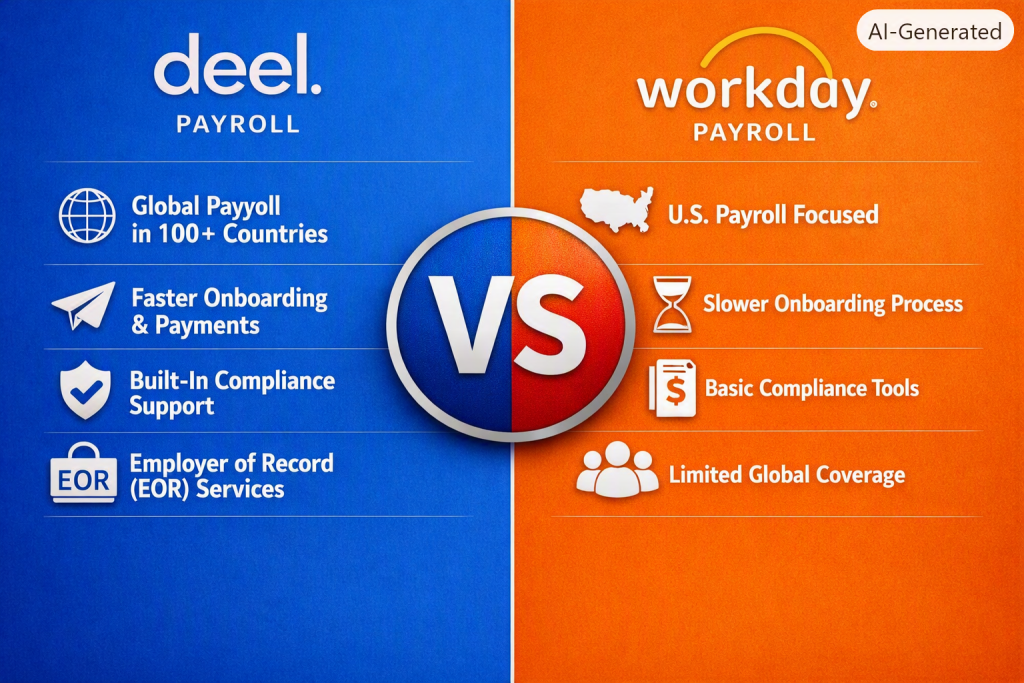
Quick Comparison
| Feature | Deel Payroll | Workday Payroll |
|---|---|---|
| Best For | Global businesses and remote teams | Medium to large enterprises |
| Payroll Coverage | 150+ countries | Native payroll in select countries with broader global payroll capabilities through Workday solutions and partners |
| Employer of Record (EOR) | Yes | No integrated EOR |
| Contractor Management | Yes | Limited |
| HR Platform | Built-in HR tools | Full Human Capital Management suite |
| Compliance Support | Global employment compliance | Enterprise compliance and governance |
| Multi-Currency Payments | Yes | Supports multinational payroll processes |
| Integrations | Extensive | Extensive enterprise integrations |
| Mobile App | Yes | Yes |
| Deployment | Cloud-based | Cloud-based |
What Is Deel Payroll?
Deel Payroll is a cloud-based global payroll platform that helps businesses hire, manage, and pay employees and contractors in more than 150 countries.
Its platform combines:
- Global payroll
- Employer of Record (EOR)
- Contractor management
- HR administration
- Compliance support
- Employee onboarding
- Multi-currency salary payments
Deel is particularly popular among startups, technology companies, remote-first organizations, and businesses expanding internationally.
What Is Workday Payroll?
Workday Payroll is part of the Workday Human Capital Management platform. It is designed to work closely with HR, finance, workforce planning, and talent management, creating a unified system for enterprise organizations.
Key capabilities include:
- Payroll processing
- Workforce planning
- Human Resources
- Benefits administration
- Talent management
- Time tracking
- Financial management
- Workforce analytics
Organizations already using Workday HCM often choose Workday Payroll because of its deep integration with the wider Workday ecosystem.
Payroll Features Compared
Deel Payroll
Deel specializes in simplifying payroll for international workforces.
Key features include:
- Global payroll processing
- Automated payroll calculations
- Multi-currency salary payments
- International contractor payments
- Digital employment contracts
- Employee self-service
- Payroll reporting
- Employer of Record services
Its focus is making international hiring and payroll easier for businesses of all sizes.
Workday Payroll
Workday Payroll provides enterprise-grade payroll functionality tightly connected with its HCM platform.
Features include:
- Automated payroll processing
- Payroll calculations
- Tax management
- Payroll reporting
- Employee self-service
- Time and attendance integration
- Workforce analytics
- Audit capabilities
Workday emphasizes centralized workforce management and enterprise reporting.
Global Payroll Capabilities
Global payroll is one of the most important considerations for multinational companies.
Deel
Deel was built specifically for international hiring. Employers can manage payroll across more than 150 countries while supporting local employment regulations, tax documentation, contracts, and salary payments from one centralized dashboard.
Workday
Workday supports multinational payroll strategies through its payroll offerings and integrations with global payroll providers in many regions. Organizations already invested in the Workday ecosystem often use these capabilities to manage payroll across multiple countries while maintaining centralized workforce data.
Employer of Record (EOR)
One of the biggest differences between the two platforms is Employer of Record services.
Deel
Deel offers integrated EOR services that enable businesses to hire employees in supported countries without establishing local legal entities.
Benefits include:
- Faster international hiring
- Simplified compliance
- Local employment contracts
- Payroll administration
- Country-specific onboarding
Workday
Workday Payroll does not include a built-in Employer of Record solution. Businesses typically work with external providers if they need EOR services.
HR Capabilities
Deel HR
Deel includes practical HR tools designed for distributed teams.
Features include:
- Employee onboarding
- Document management
- Time-off tracking
- Workforce records
- Equipment management
- Contractor administration
The platform keeps payroll and core HR functions together.
Workday HCM
Workday provides one of the industry’s most comprehensive Human Capital Management systems.
Capabilities include:
- Recruiting
- Talent management
- Performance reviews
- Compensation planning
- Workforce planning
- Learning management
- Succession planning
- Benefits administration
- Advanced workforce analytics
For enterprises seeking an all-in-one HR platform, Workday offers exceptional breadth.
Compliance
Deel
Deel assists employers with global employment compliance, including:
- Employment contracts
- Worker classification
- Country-specific labor regulations
- Payroll compliance
- Tax documentation
These tools are especially valuable for businesses expanding into multiple countries.
Workday
Workday helps organizations manage payroll governance, reporting, audit readiness, and workforce compliance through its enterprise HCM platform. Businesses remain responsible for complying with local laws, and implementation often involves configuring processes to meet regional requirements.
Integrations
Deel
Deel integrates with numerous business applications, including:
- QuickBooks
- Xero
- NetSuite
- BambooHR
- Greenhouse
- Workday
- Ashby
- Slack
These integrations streamline payroll, recruiting, HR, and accounting workflows.
Workday
Workday integrates with:
- Enterprise ERP platforms
- Financial systems
- Payroll solutions
- HR applications
- Recruiting software
- Identity management tools
- Business intelligence platforms
Its integration capabilities are designed primarily for enterprise environments.
Ease of Use
Deel
Deel offers a clean, intuitive interface designed for payroll administrators managing distributed workforces.
Even organizations with employees across multiple countries can navigate payroll tasks with relative ease.
Ease of Use: ★★★★★
Workday
Workday provides a powerful interface with extensive enterprise functionality. Because of its broad feature set, implementation and training can be more involved than simpler payroll platforms.
Ease of Use: ★★★★☆
Customer Support
Deel
Support options include:
- 24/7 live chat
- Email support
- Knowledge base
- Dedicated account managers for eligible customers
Its global support model benefits businesses operating across different time zones.
Workday
Workday offers enterprise-level customer support, online documentation, training resources, and account management. Support levels may vary depending on the organization’s subscription and implementation model.
Pricing Comparison
Neither platform publishes a universal flat-rate pricing model.
Deel Pricing
Pricing varies depending on:
- Number of workers
- Countries involved
- Global Payroll
- Employer of Record services
- Contractor management
- HR features
Businesses typically request a customized quote.
Workday Pricing
Workday generally provides customized pricing based on:
- Company size
- Number of employees
- Selected modules
- Implementation scope
- Geographic footprint
- Service requirements
Enterprise deployments often involve tailored implementation projects.
Pros and Cons
Deel Pros
- Payroll support in more than 150 countries
- Built-in Employer of Record services
- Excellent contractor management
- Strong global compliance capabilities
- Modern cloud-based platform
- Fast international onboarding
- Multi-currency salary payments
Deel Cons
- Advanced international features may be unnecessary for domestic-only businesses
- Customized pricing requires consultation
Workday Pros
- Comprehensive enterprise HCM platform
- Powerful reporting and analytics
- Deep HR integration
- Strong workforce planning
- Scalable for large organizations
- Enterprise-grade security
Workday Cons
- Implementation can be complex
- Best suited for medium and large enterprises
- No integrated Employer of Record service
- May be more than smaller businesses require
Which Platform Should You Choose?
Choose Deel if you:
- Hire employees internationally
- Manage remote teams
- Need Employer of Record services
- Pay global contractors
- Want a modern payroll platform with built-in compliance tools
- Need fast international expansion
Choose Workday Payroll if you:
- Already use Workday Human Capital Management
- Need enterprise-wide HR and payroll integration
- Require advanced workforce planning and analytics
- Manage large employee populations
- Want payroll tightly connected with finance and HR operations
Final Thought
Deel Payroll and Workday Payroll are both excellent solutions, but they solve different business challenges.
Deel is purpose-built for companies operating across borders. Its global payroll capabilities, Employer of Record services, contractor management, and compliance tools make it particularly valuable for startups, scale-ups, and organizations with remote or internationally distributed teams.
Workday Payroll, on the other hand, is a strong choice for enterprises that want payroll integrated with a comprehensive Human Capital Management platform. Its advanced workforce planning, analytics, and HR capabilities make it well suited for large organizations with complex operational requirements.
If your priority is simplifying international hiring and payroll, Deel is often the more practical solution. If your organization requires a unified enterprise HR and finance ecosystem, Workday Payroll may be the better long-term investment.
Frequently Asked Questions
Is Deel better than Workday Payroll?
It depends on your business needs. Deel is often preferred for international hiring, global payroll, and Employer of Record services, while Workday Payroll is ideal for enterprises seeking payroll integrated with a comprehensive HCM platform.
Does Workday support global payroll?
Yes. Workday supports multinational payroll strategies through its payroll capabilities and integrations, although coverage and implementation vary by country and deployment model.
Does Deel offer Employer of Record services?
Yes. Deel provides Employer of Record services that allow businesses to hire employees in supported countries without creating local legal entities.
Which platform is easier to implement?
Deel is generally quicker to deploy for organizations focused on global payroll. Workday implementations are typically more extensive because they often involve enterprise-wide HR and finance processes.
Which solution is best for startups?
Startups and fast-growing companies hiring internationally often choose Deel because of its global payroll, compliance tools, and Employer of Record services.